marquee and menu

Welcome to sreesabarisan.blogspot.com The Sree dharmasasthav sree ayyapan website....Whatever you want to know about Swami Ayyappa is here...സ്വാമിയേ ശരണമയ്യപ്പാ...


Tuesday, July 23, 2013

Lord Ayyappa of sabarimala


Lord Ayyappa of sabarimala or   Dharma Sastha as is universally called has a number of historical stories about him which his devotees heard from their  ancestors or,Guru.The Stories about Lord Dharma Sastha is also mentioned in Vedas and Puranas.  However different stories are  prevalent in different areas , depending upon the locality and places.
Lord Vishnu's " Mohini Vesham" is a well known story. After the death of Mahishasura , His sister Mahishi took a decision to take revenge against all Devas.  Hence she started Dhyanam(meditation) to please  Lord Brahma . Impressed by her bhakti, Brahma  made an   appearance and granted her wish that, nobody  in the Universe could  kill her except the son of  Lord Shiva and Vishnu.
With this boon,  she felt so   powerful that ,she started harassing Devandran and the Devas. The Devas prayed to Lord Vishnu and Lord Shiva. The venerable gods sent their shakti & spirit together to the earth in the form of  a Mahisham. There upon  the Mahishi along with Mahisham left heaven for earth and started in a jungle.
One day Lord Shiva requested Lord Vishnu to show the Mohini Vesham once more. As the Mohini appeared  in front of  Lord Shiva , Kamadeva sent his arrow at Lord Shiva and thus the disaster began for Mahishi. A male child was born(Uthram Star,wendesday )from the thigh of  Lord Vishnu . The child was born with a bell in his neck and so he was  named as Manikandan(The one who was born with a bell in his neck).  Lord Shiva took him to Kailasam.  The boy learnt all mantra and tanthra  under the tutelage living of  Lord Shiva and became a good warrior. At the age of  12, Manikandan was told about his mission of life and sent to earth as  a child.
Raja Rajasekharan  was the king of  Panthalam, a small place in southern Kerala. He was  an ardent devotee of  Lord Shiva and his queen that  of Lord Vishnu. They were childless. They prayed to god ceaselessly for a child.
One day  after hunting,  while taking  rest at the bank of river pumba , the Raja heard a child's cry . When he went for a search  with his  companions he found a child   alone in the jungle . Immediately a saint appeared and told  the king to take the child to his palace and  call him   Manikandan.
The king and queen were very happy and they brought up the child as their own. After three years, the queen gave  birth to a son and named him Raja Raja.  Manikandan was sent  to Raja Guru for learning. Manikandan completed his studies  quickly and bcame expert in all fields. When the time for leaving the Gurukul came,  Manikandan wanted to give Dakshina to his Guru. The Guru then told Manikandan to cure his son from blindness. As soon as Manikandan rubbed his hands over the eye of the boy, his vision was restored. The Guru then told Manikandan  that one day he would become Lord of the Universe. Manikandan  requested guru to keep it as a  secret and left the Gurukul.
The Panthalam Kingdom was one of the smallest kingdom, but it was rich. There were frequent attacks from other kingdoms as well as Persian countries. The Diwan was not loyal to the king. After his return from the Gurukul, Manikandan took keen interest in the affairs of the kingdom . He put an end to the internal fight among the warring kingdoms and restored law and order in the Kingdom.
One day a Muslim invader by name VAVAR   reached the coastal area of panthalam to attack the kingdom. Seeing the helpless situation of the king, Manikandan insisted on going alone for the battle with Vavar. After much persuasion, the king acceded to  Manikandan's wish.
Manikandan with his divine power temporarily closed the eyes of  Vavar who could see only Manikandan. Realising the divine power Vavar became his ardent and closest believer .
This was the beginning of a  friendship between  two people from different  religions and regions. It was a proof  that   caste, religion or  region were not barriers  for a good friendship and that humanity is above all. The mutual respect and love they shared helped them to overcome all difficulties.
Raja  started thinking of making Manikandan as the next king. The minister  did not  like this and took several steps to kill Manikandan . The Minister failed in his attempts because of the divine power of Manikandan and timely intervention of Lord Shiva.
The Minister then persuaded the queen to make her own son the next king. Persuaded by the Minister , the queen created a drama of suffering from severe headache and the  King,  believing  this, called the Diwan to bring in the best physicians to treat her. The Physician, brought  by  the  Diwan  examined  the  Queen  and told the King that the Queen had been suffering from  a  dangerous  disease  and  it  could  be  cured  only  by applying Tigress' milk. The King sent several of  his men to the forest for bringing this milk. The King understood that it was an impossible task  and  wanted  his  dear  Queen  to  be  cured  at  any  cost  and  offered half of his Kingdom to anybody who brought the milk.
Manikandan wanted to go and fetch Tigress' milk but was refused permission by the king as he was very young to go to the forest and that he was to be crowned. Understanding the situation Manikandan requested the king for a promise to do something he wanted. The King  gave  the  promise  and  Manikandan asked for permission to go to the forest. Disappointed that he was tricked the king had no other alternative but to send Manikandan to  the forest.
King  Rajasekara  made  arrangements to send a group of his loyal men along with Manikandan, which however  was  refused by Manikandan on the ground that the tigress might run away seeing the crowd of soldiers.  King  Rajasekara  sent  along with  Manikandan necessary foodstuffs and coconuts  with three eyes, in remembrance of Lord Shiva.
In the mean time Mahishi was enjoying  life along with Mahisham. However within a few days , Mahishi could guessing the plan of Lord Vishnu and Lord Shiva abandoned the Mahisham and  went to Devalok  and again started attacking Devas. Devendra and others had to run away  to seek the help of Lord Shiva,  who promised the early end of Mahishi .
In the jungle Manikandan was welcomed by the VAVAR and  Panchbutha of  Lord Shiva .On his way seeing the atrocities of Mahishi in the Devaloka,  he  went  there and  in the battle between them, Mahishi was pushed by Manikandan into the earth, where she fell on the banks of Azhutha River. Manikandan clashed with her there. At the end of    the  battle  between  Mahishi  and  Manikandan  at  Azhutha  River  banks, Manikandan   climbed   up her chest and danced violently. The impact of his dance was felt in the Earth and Devloka and the Devas were afraid. Mahishi knowing that the divine power dancing on her  body  was  none  other than the son of Hari and Haran, prostrated before Manikandan and died.  This  dance was witnessed by Lord Shiva and Mahavishnu from a place called Kalakatti   . A divine lady( Leela daughter of Karaban) came out of the body of  Mahishi and requested Manikandan to consider her as his Shakti. Manikandan expressed his inability to accept her as   his wife as he has taken Brahmcharya for welfare of  the Universe. He offered a suitable place near his temple and named her as Malikapurathamma.
Manikandan visited one of  his old devotee "Sabari" and gave salvation to her soul. He also  agreed the Sabari's request to remain   in Sabarimala for the welfare of the Universe.
  Then Lord Shiva appeared before Manikandan and told him that though he had done good for the Devas, still there was one main  task  and that was to give comfort to the King Rajasekara who was very concerned about him  and  also  to  cure  the  Queen's  ailment.  Lord  Shiva further told him that he could go to the Palace  with  the  tigresses  and Lord Indran would help him. As stated by Lord Shiva, all female devas  in  the  disguise of tigresses and male devas  as tigers with Lord Devendran as the tiger on whom Manikandan rode, started their journey to the Palace.
When   Manikandan approached the palace   with   the   tigers  and tigresses, the people who ridiculed  him  when  he started his journey to teh forest whether he wanted  toy tigresses, really got panicky seeing the violent bunch of animals and started running helter skelter.
The  Sanyasi  who  appeared  at  the  forest at the time of King Rajasekara's visit there when he heard a  child's  cries,  again  appeared  at  the  palace  and told King Rajasekara the identity of Manikandan.  Hearing this, the King stood in great surprise and silence. He stood non plused as he  saw  Manikandan  riding  a  tiger  and  people running away. Seeing the King, Manikandan descended  from the tiger's back and told him that since the tigresses were there, he could get the Queen  cured  with  their  milk.  King  Rajasekara,  fell  at  his  feet  and begged to forgivence for whatever   happened without his knowledge, and asked him to send back the tigers as the Queens ailment   had   been   cured   the moment Manikandan went to the forest.
King   Rajasekara   told   Manikandan   that the Diwan was responsible for all these things and hence   he  should  be punished. However, Manikandan told the king that he need not punish the Diwan  and  all  had happened only through the will of God.  He also gave necessary advice to Raja for the salvation of soul (Which is known as Boothanatha Geetha) . After giving necessary guidance and information for the construction of temple at Sabarimala Lord  Ayyappa(Dharma Sastha) informed   Raja ,that he is going for meditation at Ponnambalamedu for the welfare of the universe and to protect Dharma.
King Rajasekharan was heart broken hearing this and implored Ayyappa, "I have made all arrangements for your coronation and what shall I do with all the ornaments which were made for your coronation ceremony?". To this Lord Ayyappa replied, "I am entering eternal meditation for the betterment of the world. However, every year at the time of Makara Sankranthi, I will wake up from my meditation and open my eyes to see the world. At that time you may adorn my idol with all the ornaments that you have made for my coronation ceremony and Makara Jyoti will appear in   the Ponnambala Medu.  The Lord then   merged in to the idol of Lord Dharma Sastha in the Ponnamlamedu for   meditation for the welfare of the universe and  to protect Dharma .
At   the   advice   of  Saint Agasthya, King Rajasekara laid the foundation stone for the building Shabarimala   Temple.  Bhagwan Manikandan, had made it clear that he would grace only those  devotees  who offer Dharshan after performing Viradha for forty one days keeping themselves  isolated from family desires and tastes and leading a life like Brahmacharyas, thinking   of   good  things always, and that while coming for his darshan, they shall adorn themselves  with  three eyed coconut and foodstuff/Aantha Garland in their heads, as the Bhagwan did when he went to the forest to fetch tigress milk, and bathe in River Pampa raising slogans of Saranam and climb the eighteen stairs.
As graced  by  the  Bhagwan, King  Rajasekara  completed  building  of  the temple with eighteen stairs to reach  it.  When  the  King  was thinking how to put Dharmasastha's figure in the temple for  darshan to devotees, he recalled the words of the Bhagwan, the River Pampa was a holy river as  River  Ganga,  Sabarimala  was  a  holy  place as Kasi. Dharmasastha sent Parasuraman to Sabarimala   who   carved   the   figure   of    Lord   Ayyappa   and   installed   it   on the day of Makarasankranthi.  Every year lakhs and lakhs of people throng to Sabarimala irrespective of caste  or  creed  and   adorn   themselves   with   garlands  and   irumudis, chant slogans on Lord Ayyappa,   bathe   in   holy   river   Pampa, climb up the eighteen stairs and get the grace of Lord Ayyappa, the Dharmasastha.
The Jewel Casket is carried on head from the ancestral residence of the royal family of Panthalam to the Shrine on the day. A Garuda, the Brahman kite, follows this ornaments carrying procession, hovering about in the sky. After these ornaments are adorned on the Lord the bird circles the temple in the sky three times and disappears. Excited by this sight the devotees begin to chant "Swamiye Saranam Ayyappa".   A Star(Uthram Nakshathra) never seen before in the sky appears on the day of Makarajyothi day before the sighting of the Jyothi. A Jyothi is seen for a little time on the hilltop showing the presence of Swamy Ayyappan gracing his devotees. 

Pamba is the most important and holy spot.

pampa.jpg (148541 bytes)
Pamba is the most important and holy spot on   the   way to Sannidhanam. It is here Lord Ayyappa was found by King Rajasekara.ThePampa river is as holy as the ganges. The Pampa  water purifies one from curse and evil.
Pamba: Where the devotees take their holy bath  at the confluence of the three rivers(Triveni ). This   is created by the Lord as parallel to the Ganga  ( "Dakshina Ganga" ).
All pilgrim should take a dip in the Pamba river before and after  trekking the holy sabarimala. The pilgrims should also perform  "Pitru tarpanam" (offering to ones departed souls)  at Pamba before the trekking .
Triveni Sarasthadom is about 6 kms. Road transport facilities are available only up to Pampa (Triveni) on the southern bank of Pampa river. There are two bridges across the river at Triveni, one is pucca concrete footbridge and the other is a motorable bridge. Traffic through the latter bridge is not permitted during festival seasons.
On the upper side of the north bank of the river shrines of Sree Mahaganapathy. Sree Rama, Sree Anjaneya and goddess Parvathy are situated. There is a big Nadapandal adjacent to the shrines where the pilgrims take rest after worshipping these shrines.
From Pampa temple premises, foot of the Neelimala hills is at a distance of about 200 meters to the western direction of the temple. Neelimala is a very steep hill. There are two routes from here to climb Neelimala. One is the old conventional route of climbing the hills through the straight and very steep path via Appachi medu, Sabaripeedom and the other is a pathway through the slopes of Neelimala with lesser gradient but about one more kilometer in length known as Swamy Ayyappan Road constructed by Sri Subramaniam Trust. Both these Roads meet at Mara Koottam (beyond Sabaripeedom in the first route). There after the road again bifurcates one through SARAMKUTHY and the other through the lower slopes of Saramkuthy hills and meets again near the NADA PANDAL at SABARIMALA. During peak season the pilgrims are allowed to proceed to Sabarimala temple through Saramkuthy road and return through the lower road. For avoiding stampede due to heavy rush & also to facilitate  smooth passing of   pilgrims recently a subway has been constructed.
Pampa Vilakku are sailed in the Pampa river.
Pampa Feast :
Pampa Annadhanam (feast) and Pampa Vilakku are important rituals followed at the Pampa bank. Pilgrim groups prepare feast with the provisions taken from the Irumudi of the pilgrims.Thousand of pilgrims are fed at Pampa. When a group of pilgrims are ready to feed the fellow pilgrims they display a large papad outside their cottage. It is usually the kanniswamy who are fed first, as they are considered to be Lord Ayyappan himself. After the feast the Guru is honoured by way of prostration and offering of Gurudakshina by the pilgrims.
Kanni Ayyappas move from kitchen to kitchen collecting the ashes which are considered to be very sacred. It is done with the belief that Lord Ayyappa would have had the feast in one of the cottages in the disguise of a pilgrim.The ash is  considerded as prasadam.
Pampa Vilakku :
On sunset pilgrims believe that Lord Ayyappan will be present at the banks of Pampa and the cottages are decorated with lights and candles. Small floats are decorated with lights called
At Pampa also there are a few pilgrim sheds. There are three Hospitals (one Allopathy, one Ayurveda and one Homeopathy) functioning during the festival period. At Appachi Medu also one First Aid Centre functions during the peak days of festival period. One information Centre is working at Pampa Anjanayar Auditorium.There are number of information Centres at pumba for the help of Pilgrims. Pamba sadya and Pamba vilakku are

Thursday, July 18, 2013

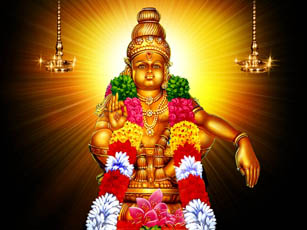
Ayyappan manikandan (Malayalam: അയ്യപ്പന്‍),(Tamil: ஐயப்பன்) (Telugu: అయ్యప్ప) (Kannada: ಅಯ್ಯಪ್ಪ) (Sanskrit: अय्यप्पः)(also called Sastavu, or Sasta) is a Hindu deity worshiped in a number of shrines across India. Ayyappan is believed to be an incarnation of Dharma Sasta, who is the offspring of Shiva and Vishnu (as Mohini, is the only female avatar of the God Vishnu) and is generally depicted in a yogic posture, wearing a jewel around his neck, hence named Manikandan. Ayyappan may bear a historical relationship to the tutelary deity Aiyanar in Tamil Nadu.[1]
By the 20th century, there has been an increase in the number of worshipers of Ayyappan from many different groups, spurred by vast improvements in transport and communication in southern India.[2]
Ayyappan's annual festival is a time of pilgrimage for ever-growing numbers of men from throughout South India. The most prominent and famous Ayyappan shrine is the one at Sabarimala, in the hills of Pathanamthitta in Kerala, with over 30 million devotees visiting it every year,[3] making it one of the largest pilgrimage sites in the world. These devotees fast and engage in austerities under the leadership of a teacher for weeks beforehand and then travel in groups to the shrine for a glimpse of Ayyappan. Bus tickets are hard to obtain for several weeks as masses of elated men, clad in distinctive ritual dhotis of various colors, throng public transportation during their trip to the shrine.[4]
The name "Ayyappan" is used as a respectful form of address in the Malayalam and Tamil languages. The Tamil and Malayalam sentence Swamiye Sharanam Ayyappa can be translated as, "Oh Ayyappa! I seek refuge in you".[5]

Etymology

Ayyappa is known as "Hariharasuta" because he is the son of Hari (Vishnu), the saviour and Hara (Shiva), the destroyer. His most common name is "Manikanda" because when the king Rajasekara Pandiyan of Pandalam found little Ayyappan in a forest, there was a "mani" (jewel, in Sanskrit) tied around his "kanṭha" (neck, in Sanskrit).[6][7]
As Dharma Sastha, many of them consider him to be born out of the union between Mohini (an avatar of Vishnu) and Shiva.[8]

Legends surrounding Ayyappan

The asura princess Mahishi was burning up with anger at the trick the gods had pulled on her brother, the asura king Mahishasura. As Mahishasura was blessed with invulnerability to all men, the gods had sent goddess Durga, to fight and kill him. Thus, Mahishi began performing a fearsome set of austerities, and pleased the creator god Brahma. She asked for the boon of invulnerability, but Brahma said it was not possible so Mahishi planned and asked invulnerability to all men except by the son of Shiva and Vishnu (Both are male & no possibility to give birth to any one). He granted her the boon of ruling the universe and being invulnerable except by the son of Shiva and Vishnu. Since such a person did not exist, she thought she was safe and began conquering and plundering the world.
The gods implored Shiva and Vishnu to save them from this catastrophe. Vishnu found a possible solution to the problem. When Vishnu had taken on the Kurma Avatar, he also had to manifest himself as Mohini, the enchantress, to save the nectar of immortality (ambrosia or amrit) from the demons who were not willing to share it with the gods. If he became Mohini again, then the female Mohini and the male Shiva could have the divine child who would combine their powers and beat Mahishi.
Some versions give a slightly more detailed version of the union of Shiva with Vishnu. One version tells that the asura Bhasmasura had so pleased Lord Shiva with his austerities that Shiva gave him a boon of anything he wished. So Bhasmasura asked for the ability to burn to ashes anything which he placed his hand over. No sooner had Shiva granted this, than Bhasmasura ran after the god, threatening to turn him to ashes.
Shiva called to Lord Vishnu for help. He hide himself in a peepal tree as Bhasmasura ran here and there searching for the god. Vishnu became aware of the events, and decided that he would take the female form Mohini, "the Enchanting", and try to trump the asura's powers. When Bhasmasura saw Vishnu in this form, he was bewitched by her beauty. He earnestly tried to court her. So Vishnu instructed Bhasmasura to hold his hand over his head, and vow fidelity. With this act, Bhasmasura was reduced to ashes.
Vishnu found Shiva and explained the whole affair to him. Shiva asked if he too could see Vishnu in this female form. When Vishnu appeared thus, Shiva was overcome with passion, and united with her. The two gods thus became "Harihara Murthi", that is a composite form of Shiva and Vishnu as one god.
From this union, Lord Sree Dharma Sastha was born. He combined in himself the powers of Vishnu and Shiva. Lord Ayyappan is an incarnation of Lord Sree Dharma Sastha and Lord Ayyappan is a visible embodiment of their essential identity. Sri Ayyappa belongs to Pandya Royal Community. He was the head of a clan. It is believed Sri Ayyappa merged to sri dharma sastha. Lord Vishnu gifted the new-born deity with a little bejeweled bell necklace, so this god is called Manikandan. He is also Known as Dharma Shasthavu,Kerala Puthran.

Others legends

There are many popular stories associated with Him among the devotees. The stories differ, but there are certain common elements:
  • Ayyappa lived in the Pandalam Palace as the son / savior of the King.
  • He had super-human or divine knowledge, wisdom, and courage and loved the King and his people.
  • He protected the King and the kingdom from the attacks of enemies.
  • At the end of His life in Pandalam, He vanished into the forests and is ever since worshiped at the Sabarimala temple.
The most popular and widely accepted story tells that Lord Ayyappa had His human sojourn as the son of the Raja of Pandalam. At that time, Raja Rajasekhara ruled the kingdom of Pandalam. During one of his hunting expeditions, the Raja was puzzled to hear the wails of a child on the banks of the river Pampa, and was surprised to find a resplendent infant there. The beautiful baby with radiant face wore a bead ('mani') around his neck. The King, though pious, charitable, just, and God-fearing, had no children. He accepted the child as God's gracious response to his fervent prayer for an heir to his throne. Manikantan grew into a boy well versed in academic lore and martial arts. Meanwhile the Rani gave birth to a son. The King regarded Manikantan as his elder son. He decided to crown him as the Yuvaraja. The King's corrupt Minister had a deep dislike for Manikantan, and made the innocent Queen believe that ill would befall her if Manikantan was crowned Yuvaraja and that the kingdom actually belonged to her son.
They conspired to get rid of Manikantan by hook or crook. They bribed the royal physician into becoming an accomplice of theirs. The Rani pretended to be afflicted with severe pain in the stomach, and the physician prescribed the milk of a tigress as the only cure. The King knew that none could be deputed for a mission that was so patently suicidal. However, the youthful and valiant Manikantan stepped forth and volunteered to fetch the milk. Despite the worried protestations of his foster-father, he set out for the fearful forests.
Days later, Manikantan entered the palace precincts riding a fierce tigres and followed by a pack of its cubs. The schemers were frightened into confessing their nefarious plot. They and others now knew that Manikandan was no ordinary being. They were convinced of His divine origins, and prayed to Him to be with them for their own salvation and for the safety of the kingdom. However, Manikandan was now determined to leave the place.
Filled with happiness, grief, fear, wonder and 'bhakti' (devotion to God) and self-surrender, the king prayed for the mercy and blessings of Manikantan. He repented he could not fully visualize the truth of the divine powers of the Lord and repeatedly requested Him to forgive him for behaving as if He were only his son. The Lord lovingly embraced the King who continued to pray: " Lord, kindly bless me by freeing me from my egos and the worldly life of birth and rebirth and grant me ' moksha’ (salvation). Kindly continue to be the saviour of my family and stay eternally in my kingdom.” Manikandan then enlightened the King on the path of attainment of 'moksha'. These words of the Lord are contained in ‘Bhuthanathageetha'. To the King who is by now mentally cleansed and completely immersed in 'bhakthi', Lord Ayyappa said: "I am to free you from all worldly sorrows & worries and to grant you 'moksha'. All those who are and would be born in your family shall have my blessings unfailingly. I am always accessible to 'bhakthi' and only 'bhakthi." The Lord told the King that he could construct a temple at Sabarimala, north of the holy river Pampa and install His deity there. Ayyappa also explained how the Sabarimala pilgrimage shall be undertaken, emphasizing the importance of 'vrutham' and what the devotees can attain by His 'darshan'.
The Lord further consoled the King saying that the devotees who held him and his descendants in 'bhakthi' shall happen to be devoted to Him as well. Manikantan then blessed the King and all others assembled there, and vanished. The King duly constructed the temple at Sabarimala, dedicated to Him.
There are various tales connected with Lord Ayyappa: the discovery of the child at Pampa, Manikantan's youthful days in the Pandalam palace, bestowing the power of hearing and speaking upon the deaf and dumb son of His teacher as Guru-dakshina, His friendship with Vavar, bringing the tigress's milk, accomplishing His divinely destined mission of annihilation of the demoness Mahishi, eliminating the forest-thug Udayanan, bestowing moksha on Sabari, blessing His foster-father with moksha and so on. Legend also goes to say that Manikantan was the incarnation of Lord Dharma Sastha. Raja Rajasekhara was in his previous birth a rich and pious 'Brahmin ' by name Vijayan who was a very strong believer and devotee of Lord Dharma Sastha.
Another tale goes like this: Lord Ayyappan as Manikandan born to Pandala Maharaja is set to conquer the King Udayan who is a strong Buddhist and has been harassing the people of Pamba region. Maharaja sends Manikandan to learn martial arts Kalari to Cheerappanchira, the Muhamma of today in Alappuzha district. The panicker there trains him of Kalari. It is here where the Guru's daughter Nila falls in love with Lord Ayyappa (Manikandan) but He refuses to marry telling he is a Bhrammachari and has a mission. She offers a sweet made out in a function in their family which Lord likes. This sweet payasam was what turned out to be the Aravanapayasam today.
A Holy Song that is used to wake up Ayyappan in Sabarimala temple is known as Ayyappa Suprabhatham,an another song which for making ayyappa sleep is the famous song Harivarasanam.
Lord Ayyappan and Seven Chakras
There are Seven Chakras Every Human has this aspect
    Mooladharam     
    Swathishtanam
    Manipooragam, 
    Anagadham, 
    Vishuddhi, 
    Aagna, 
    Bhrammarandram
Lord Dharmasastha Temples Associated with 7 chakras
   Brahmmarandra - Crown chakra          - Kanthamala , where Makarajothi Appears 
   Aagna         - Third eye chakra      - Sabarimala
   Vishuddhi     - Throat chakra.        - Pandalam 
   Anagatham     - Hearth chakra         - Kulathupuzha
   Manipooraga   - Solar plexus chakra   - Ariyankavu
   Swathishtana  - Sacral chakra         - Achankovil 
   Mooladharam   - Root Chakra           - Sori Muthu ayyannar temple Papanasam near Karayar
                                           Tamilnadu

 SREE AYYAPPA SWAMY TEMPLE

 
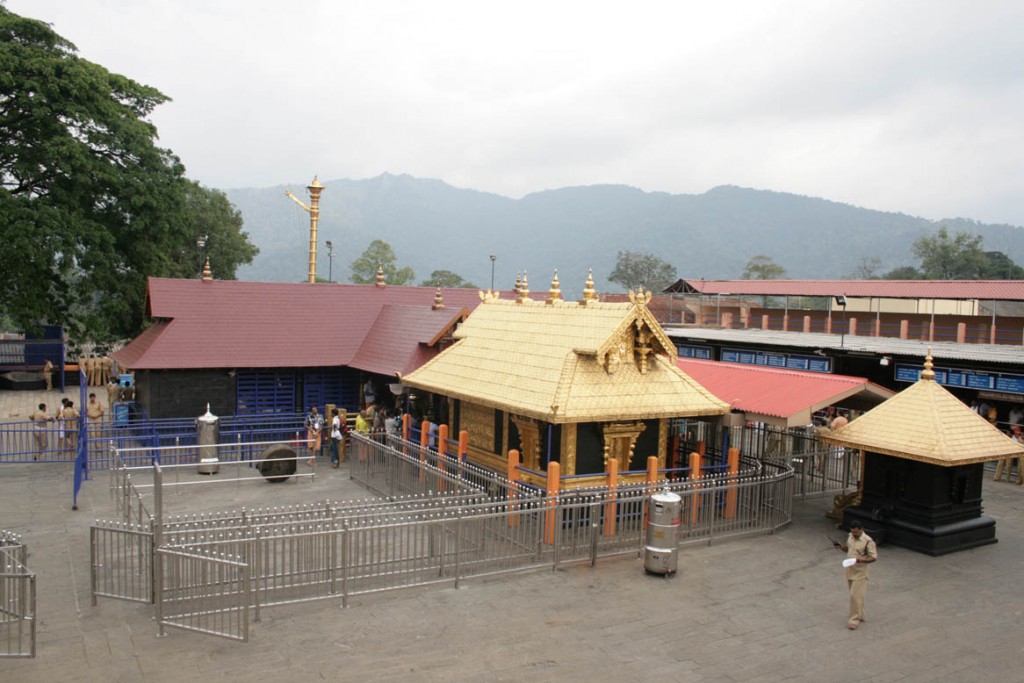
Sabarimala Sree Ayyappa Temple which attracts millions of devotees every year from all over the country and abroad, is one of the ancient mountain shrines situated in a deep, dense forest on the virgin hill of Sabari, in the Ranni-Perunad village of Pathanamthitta district of Kerala, in South India.
                   Surrounded by lush tropical jungles and 18 hills, the shrine is over 4000 ft above sea level. Sabarimala is part of Sahyadris (Western Ghats); remnants of ancient temples are visible in the adjoining hills and at Nilackal, Kalaketi and Karimala offerings are still made to the devis/devas.
The Temple which can be reached only on foot has been captivating devotees from ancient times. The arduous trek of nearly four kilometres through the thick jungle, after crossing River Pampa, has been a source of spiritual chastisement and cleansing for the devotees who visit the shrine every year driven by divine magnetism.
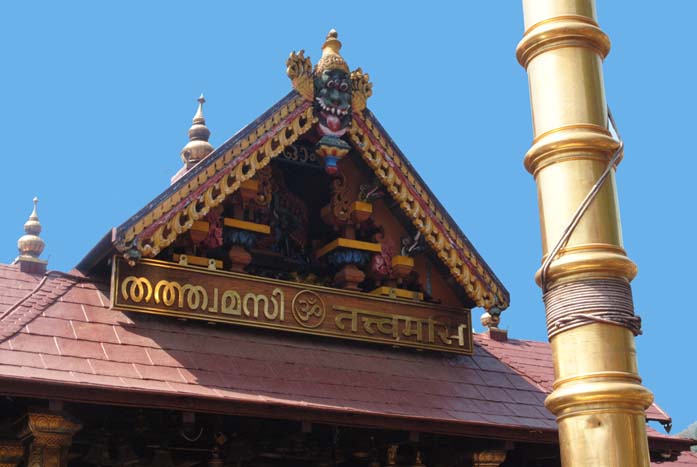
Vavar Thara’ is located close to the Shri Ayyappa temple. Legend has it that Vavar, a sufi saint, was close to Swami Ayyappa. Location of ‘Vavar Nada’ in the premises of Swami Ayyappa temple and the custom of Ayyappa devotees offering their prayers at the Vavar Nada are hailed as fine examples of secularism and communal harmony. Another significant aspect of Sabarimala pilgrimage is that pilgrims, irrespective of cast or religion or wealth are considered equal before Lord Ayyapa and all of them address each other as Ayyappa or Swamy (in the true spirit of the words Thatwamasi).
 
 
It is believed that the deity of the temple was consecrated by Lord Parasurama at the foot of Sabari hills, reference to this is said to have been made in Ramayana. The temple attracts pilgrims from the southern states of Kerala, Tamil Nadu, Karnataka and Andhra Pradesh and also from the other states and from the other countries. Another mythology says that Sabarimala is the place where Lord Ayyapa meditated and became one with Lord Sastha soon after killing the powerful demon, Mahishi.


Ping Blog Hostgator promo code dreamhost coupons free search engine submission dreamhost coupon host gator coupon hostgator coupon